
The Most Expensive Words in B2B Sales May Be “I’ll Get Back to You"
Use this 12-question B2B meeting stress test to see whether your sales team can answer difficult buyer questions clearly, credibly, and before confidence slips.
The B2B Meeting Stress Test: 12 questions that reveal whether your sales team can build confidence when the script runs out
The demo is going well.
The buyer understands the problem. The product looks relevant. Then the operations director asks:
“What normally goes wrong during implementation?”
The sales professional pauses.
“That is probably one for our implementation team. I’ll come back to you.”
The meeting does not collapse. Nobody gets angry. The buyer may even smile and say, “No problem.”
But something changed.
Ten seconds earlier, the buyer was evaluating the product. Now the buyer is evaluating whether your company really understands what happens after the contract is signed.
That is the meeting most companies are not training for.
They train the pitch. They polish the deck. They rehearse the demo. They write objection-handling documents that sit in a folder nobody can search while six people are staring through a webcam.
Then they act surprised when a deal slows down after what everyone described as “a good call.”
A good call is not the goal.
Buyer confidence is the goal.
And buyer confidence is usually won or lost when the conversation leaves the script.
Why “I’ll get back to you” costs more than you think
There is nothing dishonest about not knowing an answer. Pretending is worse.
But a delayed answer is not neutral.
Research published in the Journal of Personality and Social Psychology found that response delays can reduce perceived sincerity. The research was not conducted specifically in B2B sales meetings, so we should not turn it into a fake sales statistic. The broader psychological point still matters. People interpret the speed of an answer as information about the person giving it.
The buyer does not hear only, “I need to check.”
They may also hear:
“This is not as straightforward as I was told.”
“This person does not know what happens after the sale.”
“There may be risk here that has not been explained.”
“I will have to do more work before I can trust this decision.”
That last one matters because the buyer already has enough work.
According to Gartner research published in May 2026, 69% of surveyed B2B buyers turned to sales professionals to validate insights they had received from AI.
That is the opportunity.
The sales professional is no longer there merely to provide information. They are there when the buyer needs interpretation, judgment, context, and confidence.
You do not win that moment by repeating the website.
You win it by being useful when the question becomes specific.
Your brain was never designed to be the company database
Sales leaders often create an impossible job.
They expect one person to remember product details, integration requirements, security language, pricing rules, implementation risks, customer evidence, competitive positioning, legal limitations, and the next discovery question.
While listening.
While presenting.
While reading the room.
Human working memory is severely limited. In his influential paper, psychologist Nelson Cowan proposed a central working-memory capacity of roughly four meaningful chunks of information, although the precise limit depends on the task and how information is organized.
So no, the answer is not another 80-page playbook.
The answer is not “train harder” every time a sales professional cannot retrieve one sentence from page 47 while a procurement director is waiting.
Stop confusing competence with memorization.
Teams have always solved this through what psychologists call transactive memory.
In plain English, a strong team does not require every person to know everything. It requires people to know where expertise lives, whose knowledge can be trusted, and how to retrieve that knowledge when it is needed.
Research into transactive memory systems describes how teams distribute, coordinate, and retrieve specialized knowledge through a shared understanding of who knows what.
That works when the technical expert is in the meeting.
It fails when they are on vacation, in another call, or supporting seven other deals.
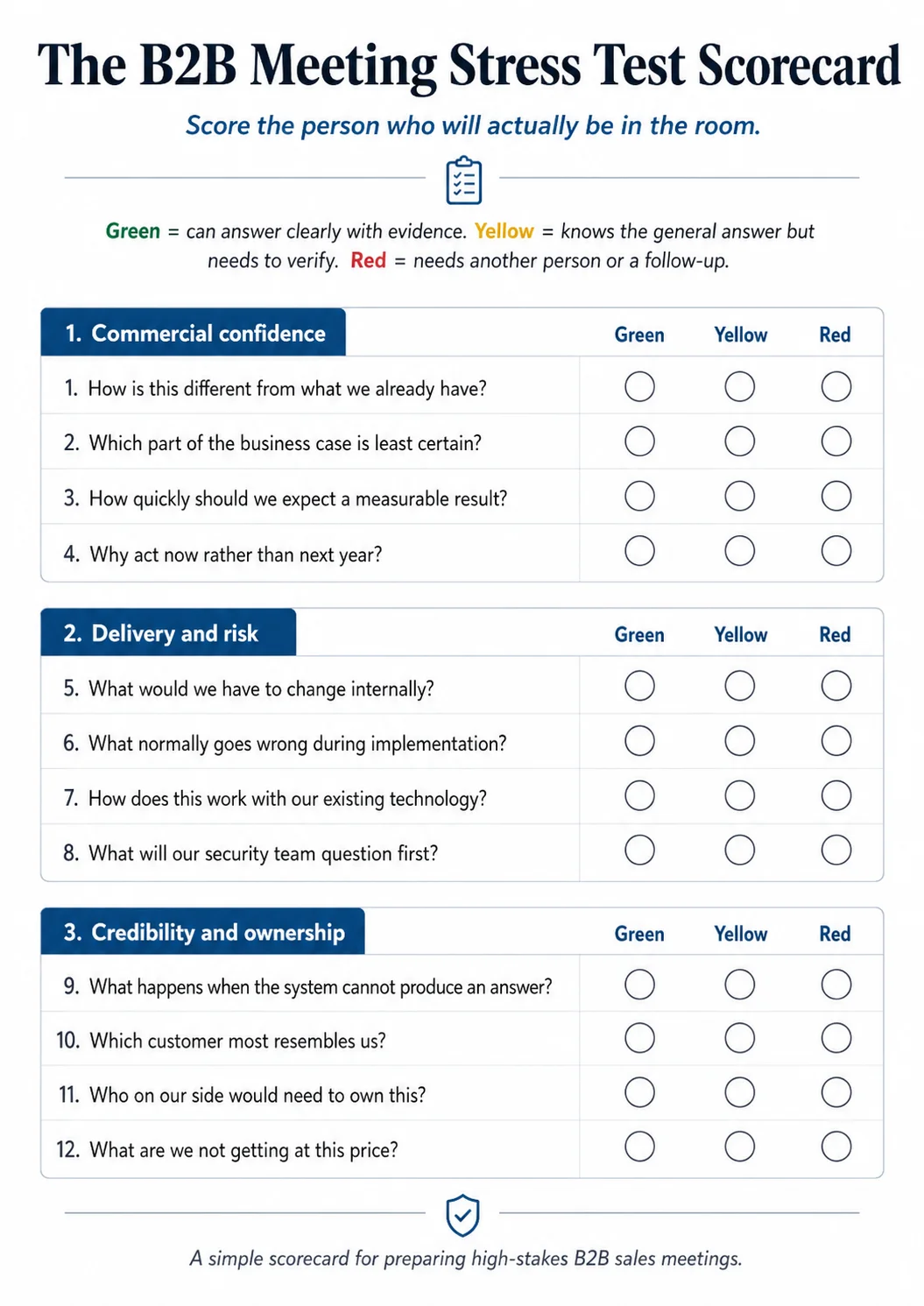
The 12-question meeting stress test
Take your next important opportunity and answer these questions honestly.
Green means you can answer clearly, accurately, and with evidence during the meeting.
Yellow means you know the general answer but need to verify important details.
Red means you need another person, several systems, or a follow-up email.
Do not score the company.
Score the person who will actually be in the room.
1. What would we have to change internally to make this work?
The buyer is testing implementation reality.
A vague answer tells them you understand your product but not their operating environment.
2. How is this different from using what we already have?
This is not always an objection.
It is often a request for the economic difference between action and inertia.
Do not answer with a list of features. Explain what becomes possible, faster, safer, or less expensive.
3. What normally goes wrong during implementation?
The worst answer is “nothing.”
A credible answer names the risks, explains how they are managed, and shows that your company has learned from experience.
Perfect answers create suspicion. Experienced answers create confidence.
4. Which part of the business case is least certain?
Buyers know forecasts contain assumptions.
Honesty about uncertainty can demonstrate judgment. Pretending there is no uncertainty makes the entire case feel manufactured.
5. What happens when the system cannot produce an answer?
Every product has limits.
The buyer wants to understand the failure mode, escalation path, and human fallback.
They are not necessarily trying to catch you out. They are trying to understand what happens on a bad day.
6. How does this work with our existing technology?
“Through an API” is not an implementation answer.
What connects? What changes? Who owns it? Where does complexity usually appear?
The buyer is not buying an API. They are buying the consequences of connecting it.
7. What will our security team question first?
The buyer may be preparing for an internal conversation that you will not attend.
Help them carry the case forward instead of forcing them to translate your product alone.
8. Which customer most resembles us?
A famous logo is not automatically relevant evidence.
The buyer wants a customer with a comparable problem, operating model, scale, technical environment, or commercial constraint.
Relevance beats fame.
9. How quickly should we expect a measurable result?
The answer needs a starting point, a realistic sequence, and a definition of what “result” means.
Fast is not a metric.
10. Who on our side would need to own this?
Software without ownership becomes shelfware.
This question is about organizational effort, accountability, and whether the buyer can realistically make the change happen.
11. What are we not getting at this price?
A clear boundary can build more confidence than a slippery promise.
It gives the buyer something concrete to evaluate. It also shows that your company understands the difference between selling and saying yes to everything.
12. Why should we act now rather than revisit this next year?
Do not manufacture urgency.
Connect delay to an actual business cost, delayed opportunity, operational consideration, or strategic dependency.
If there is no credible cost of waiting, say so.
Trust is not built by forcing urgency where none exists.
What your reflection is really exploring
This is not a trivia test.
It helps you reflect on how clearly the conversation reduced uncertainty while the customer was making sense of the decision.
A widely used model of organizational trust identifies ability, benevolence, and integrity as three foundations of perceived trustworthiness.
That model maps remarkably well to a complex sales meeting.
Ability: Do you understand the problem and know how the product works?
Benevolence: Are you helping the buyer make the right decision, including when the answer is uncomfortable?
Integrity: Are your answers consistent with the evidence and with what your company will actually deliver?
The strongest answer is not always the fastest or most confident answer.
Psychological research into processing fluency has shown that information that is easier to process can sometimes feel more truthful. That is useful to understand, but dangerous to misuse.
Fluency is not accuracy.
A smooth lie is still a lie.
The commercial standard should be speed plus evidence.
Not improvisation.
Not a confident hallucination.
Not a generic AI answer pulled from the internet.
The answer should be grounded in approved pricing, implementation documents, security material, case studies, product guidance, and commercial rules.
Bring the missing colleague into the room
The best person to answer a difficult buyer question is often the person who could not attend.
The product manager who understands the limitation.
The security lead who knows why the architecture was designed that way.
The implementation consultant who has seen the issue before.
Headsum turns that distributed company knowledge into live support for the person in the meeting.
It detects questions, objections, and buying signals, then surfaces coaching cards and grounded answers while the conversation is still happening. Teams can load approved material into a shared knowledge library, allowing answers to come from what the company actually knows rather than whatever the sales professional happens to remember.
You can read more about how Headsum supports sales professionals during live meetings.
Headsum is not there to replace the sales professional.
It is there so the sales professional does not have to choose between listening to the buyer and searching through six tabs.
It is the technical colleague who was double-booked.
The sales leader who cannot sit in every call.
The customer story you knew existed but could not find.
The answer that arrives before the moment is gone.
Run the test before your next meeting
Choose one live opportunity.
Mark the 12 questions green, yellow, or red.
Then collect the documents containing the real answers. Bring together the product material, pricing rules, security guidance, implementation notes, customer examples, and approved competitive positioning.
Load them into Headsum.
Take the meeting again, this time with your company’s knowledge beside you.
Your sales professional does not need to know everything.
They need the right answer, from the right source, while the buyer is still asking.
Sources and further reading
Gartner. “B2B Buyer Survey on Validating AI-Generated Insights.” May 20, 2026.